

To contribute to this site, see above menu item "About".
These transcriptions may contain human errors.
As always, confirm these, as you would any other source material.
New Perlican and the Heroes of The Newfoundland Sealing Disaster
by
The sealing disaster of 1914 occupies a storied place in the collective historical memory of Newfoundlanders. There has been much written about this defining event in Newfoundland’s history. The most well-known authors: Cassie Brown, Death on the Ice (1972), Shannon Ryan, The Ice Hunters (1994), Gary Collins, Left to Die (2014), and Jenny Higgins, Perished (2024).
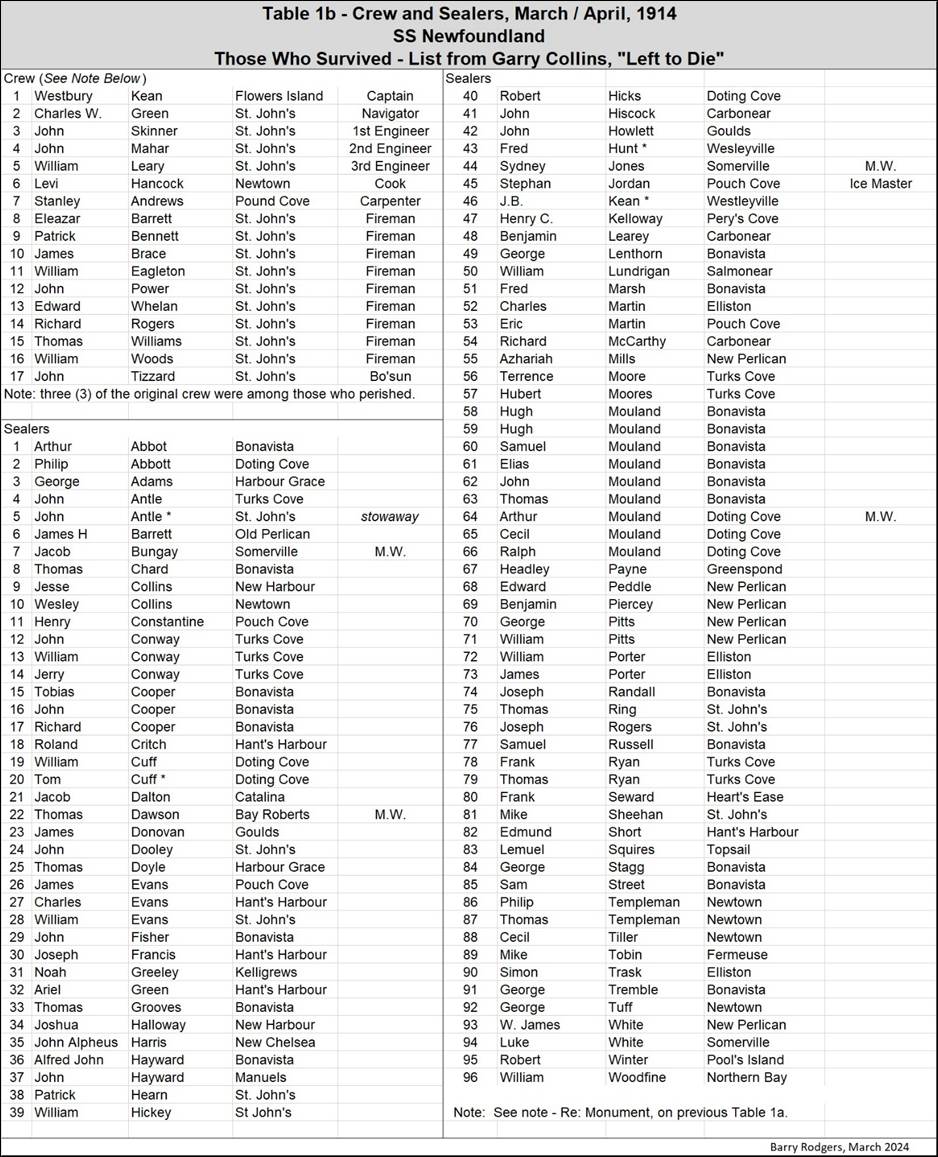
This essay explores a different angle, focusing, not on those who perished, but on those sealers who survived. The essay also serves to recall the contribution and sacrifice of a number of local communities along the short 20 kilometer (12 mile) stretch of the East Trinity Bay coast from New Pelican to New Chelsea. Of the 166 sealers, 25 were from these communities, 26 when the area is extended to include Old Perlican. Here are the names:
|
New Perlican |
Winterton
Hant's Harbour |
|
Turks Cove |
New Chelsea
Old Perlican |
Note: Only one “Moore” family is identified in the 1921 Turks Cove census, that of Terrence, age 47. While no family, “Moores”, is identified, Terrence’s brother, Philip is listed, age 49. Hubert Moores is taken to be Philip Moore. Similarly, only one Ryan family is listed, Frank (82) and his son Francis (28).
Of the 10 New Perlican men, 4 perished. As did Fred Pearcey (Winterton) and Alan Warren (Hant’s Harbour). These were times when class divide was very real. Authority was not hesitant to direct downward, and the consequences of resistance could be dire. Few could imagine how things could be any other way! Perhaps the very characterization of this defining event as a disaster, and not a tragedy, reveals something important to be remembered?
Crews and Sealers – An Explanation of the Numbers:There is still to this day confusion over some of the numbers representing important details of the Newfoundland sealing tragedy of 1914. Lacking modern recording and reporting technologies, this was not uncommon for the times. And with tragedy, one must expect confused sources and reporting.
The source of confusion starts with what one might see as the primary source document - the sign-on agreement (The Agreement) from the SS Newfoundland. The Agreement identifies 186 men, 20 crew and 166 sealers. Five names were missing. Gary Collins identifies these men: the stowaway, John Antle (St. John’s), Tom Cuff (Doting Cove), Stephen Donovan (Goulds), Fred Hunt (Wesleyville), and J.B. Kean (Wesleyville).
The identification of 166 sealers as starting the hunt on the morning of March 31st is important. This number is commonly quoted. It seems, though all-to-often, to be based on the original crew list, when in fact there were 171 sealers. It seems too that this difference (171 – 166) represents 5 sealers who never left the ship – did not go sealing at all. We also know that 4 of the crew went sealing, 3 of whom perished. This implying that an additional 4 sealers also did not leave the ship, since 4 of the crew were with the sealers.
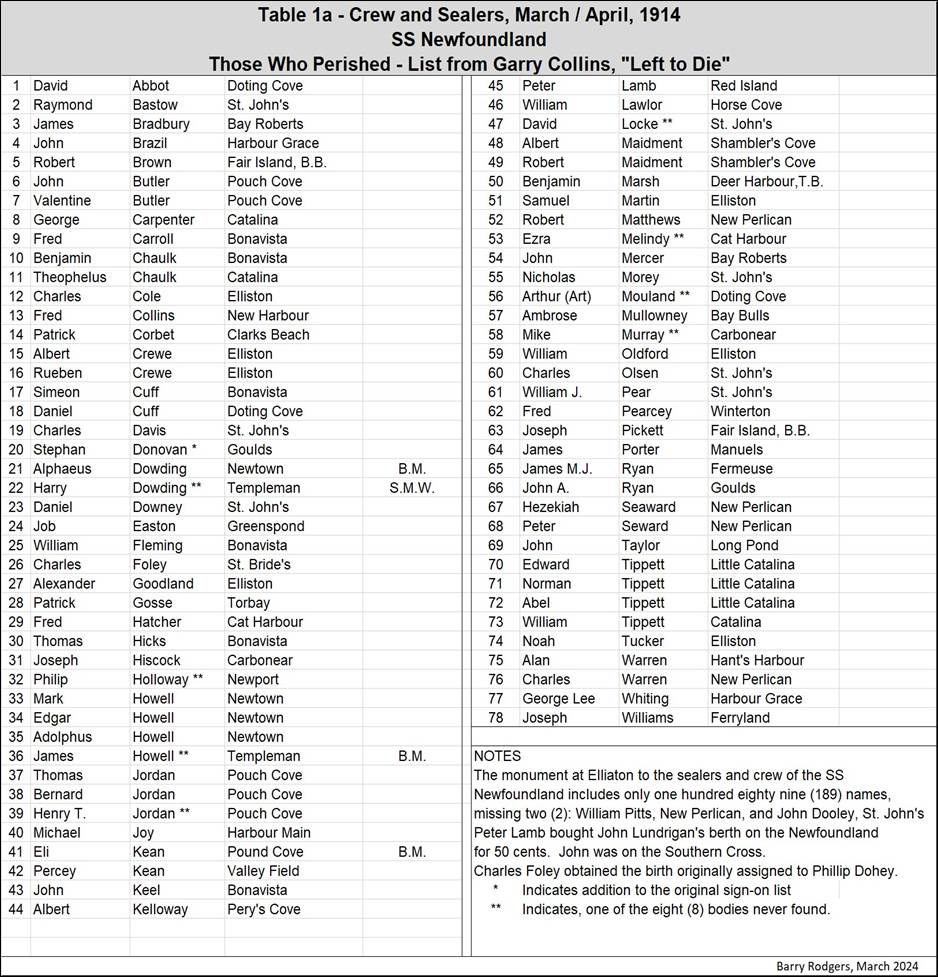
We know that 77 men perished in the storm. William Coaker’s Log identified, as returning on the SS Bellaventure, "69 dead forms of human freight" (from 77 dead, with 8 men never found. We can also include among the perished John Keel, who died in hospital some two weeks after rescue, bringing the total perished to 78. All who perished were returned on the Bellaventure.
The Evening Telegram produced a list of those who returned on the Newfoundland, reporting that the ship “entered port … with 125 [77 + 48] men short of the crew that she left here with, 77 of whom perished and 48 survivors, more or less injured”. Coaker had reported 46 survivors. From Wes Kean’s count, there were actually 55 survivors.
More confusion is caused when the article identifies “the names of all who came back on the Newfoundland”. The associated list contained 62 names, implying a total ships complement of 187 (62 + 125), not 191, but seemingly, adding the stowaway.
Those returning on the Newfoundland included 3 men who were on the ice for the storm but did not return on the Bellaventure – George Tuff, Arthur Mouland, and Elias Mouland. Jenny Higgins (Perished, p. 48) tells us that, after boarding the Bellaventure to identify the dead, “… he [Wes Kean] counted 69 bodies and 55 survivors”.
With 62 returning on the Newfoundland, 69 dead on the Bellaventure, and 8 men never found, 52 (191 – 62 – 69 – 8) of the survivors must have returned on the Bellaventure.
How many men endured the storm on the ice? All those returning aboard the Bellaventure, plus 8 that were never found, plus 3 that transferred to the Newfoundland, and the 52 survivors that returned on the Bellaventure (69 + 8 + 3 + 52); thus, 132. With 34 men recorded in the Chief Officer’s Log as having returned to the Newfoundland, 166 (132 + 34) men actually participated in the hunt. This means that 25 (191 – 166) never left the ship, of which, 16 were crew and 9 sealers. The number of men who actually participated in the hunt is the same as the number of sealers identified in The Agreement, but for different reasons. The number of sealers (166) based on The Agreement does not include the 5 missing names or the 4 crew members who also went sealing. Nor does it exclude the 9 sealers who did not leave the ship at all that day.
The Tragedy:
The total loss of life in the 1914 sealing disaster sums to 251 men, including
seventy-eight (78) from the Newfoundland and all 173 from the SS
Southern Cross. This says nothing of the 113 survivors from the Newfoundland,
some of whom suffered related infirmities, including
amputations. Not to mention the psychological trauma that all
suffered, no doubt for the rest of their lives. Their families
too.
Every sealer knew that theirs was a difficult and dangerous job. But they did their duty anyway - for themselves, their families, and their communities. Not to do so would be to invite even harsher economic circumstances for those who already had nowhere near enough! To put it mildly.
Of the total number of sealers who began the hunt in the early morning of March 31st, a number of these men, anticipating an impending storm, decided (beginning at about 10:00 AM), to return to the Newfoundland, arriving at the ship around 1:30 PM.
While all are heroes, this essay singles out for special recognition, the thirty-four (34) who braved both ridicule and the loss of much needed wages, to defy authorities, who did have enough. Ony the following of these men have so far been identified:
· Tobias Cooper, Bonavista
– first to turn around and arrive back to the ship
· Roland Critch, Hant’s Harbour
· Charlie Evans, Hant’s Harbour
· James Evans, Pouch Cove
· William Evans, St. John’s
· Joe Francis, Hant’s Harbour
· John Harris, New Chelsea
· Stephan Jordan, Ice Master, Pouch Cove
· James Porter, Elliston
· William Porter, Elliston
· Edmund Short, Hant’s Harbour
Edmond
Short, age 24, explained his reasoning:
I
turned back because I thought it was going to be stormy, and
I did not see anything ahead of me but death.
Jenny Higgins, Perished,
p. 35
Described, or otherwise referred to, as “cowards”[1], “quit[ters]” [2], and “stragglers”[3], these thirty-four (34) men have been overlooked, ignored, and swept aside. However, their perspective is important. Of course, it hardly needs to be stated that this in no way takes away from the hardship, sacrifice, and heroism of the others, survivors and victims.
Deliberating among themselves about whether to return to the ship,
Alpheus John Harris, New Chelsea, age 52, the oldest of the first group to turn
around, would declare:
I don’t need Tom Dawson to tell me what to do. There’s a starm comin’ up, an’ ‘e should be here right now t’ lead us back to the ship, but I can get there without ‘e’s help.
Cassie Brown, Death On The Ice, p. 61
The first to turn around, and arrive back onboard the Newfoundland, was Tobias Cooper, Bonavista. Immediately Interrogated and dressed down by Captain Kean, for returning, Cooper explained:
We didn’t see anything to go on fer, sir. … We saw the crowd a’ead of us climbin’ the pinnacles looking fer seals an’ findin’ none, sir. Then we was outdistanced be the others. ‘Twas plain wedder was coming on, so we come back, sir”.
Gary Collins, Left to Die, p. 262
The following
quotations are taken directly from the Report of The Commission of Enquiry
into The Sealing Disasters of 1914, February, 1915.
At about ten o'clock some
men who had killed half a dozen seals, returned to the ship with four of the
seals, and a number of other men, in all some twenty-nine also fell behind and
returned. Various reasons are given by these men for their return, some claiming
that they had done so because the weather had become bad, others denying that
and stating that they had gone upon the ice merely to kill a stray seal or two
and to bring them on 'board, and that having killed what seals were in sight
they had completed their work. Others said that the Stephano was too far
distant for them to reach, and seeing that she was moving still further away
from them they felt justified in giving up the walk.
Justices
Horwood and Emerson, p. 4
Some thirty others saw well
to return to the Newfoundland from a point about half way to the Stephano. Two
or three of these thirty were called before the Commission. To my mind they did
not justify their return.
Justice,
Johnson, p. 22
These sealers were deeply experienced and, as such, could see clearly the signs of the oncoming storm. They knew what they were doing! - before others did, some of whom, who did not bear the risks, would be proved tragically wrong. It was not just “two or three”.
Thirty-four (34) men represents twenty percent (20%) of the sealers. One in five (1/5) of the sealers, many with decades of previous experience, thought best to forego a significant part of their, much needed, present, and likely, future, livelihood, and return to the ship, having first watched weather conditions worsen throughout the morning. And the Commission remained unconvinced! I dare say that many, then and now, remain unconvinced of the Commission’s reasoning.
Historian, Shannon Ryan, reported: “… the thirty-four men who … were returning to the Newfoundland discovered that it was only by following the vessel's whistle that they were able to find the ship in the thickening storm around 1:00 or 1:30 p.m.”.
Despite the Commissioners’ obvious indifference to these men, at least officially, it hardly seems convincing that, with the livelihoods of themselves and their families at stake, these men would have been there “merely to kill a stray seal or two”.
Men like Cooper, Harris, Short, Jordan, and the others, afford the real-life examples from which important lessons of history may be drawn. The lessons that see more than short run personal perception and economic expediency, and more than extreme economic inequality. These men held a deep knowledge of their natural environment upon which to base their reasoning, and they combined this expert knowledge with deliberation and the courage to action. It is undisputable that, ultimately, the leader, or leaders, of the thirty-four (34) who returned, surely saved lives, and the families of those involved, unimaginable grief.
Postscript:
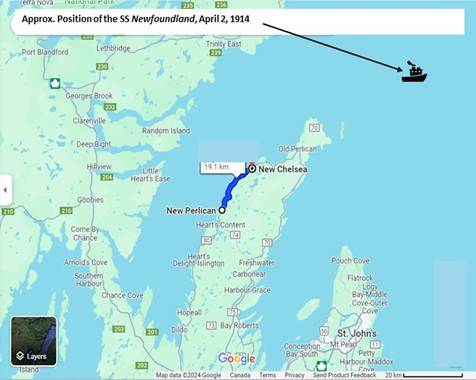 It is not commonly realized that
this infamous disaster did not take place far out into the Atlantic. It took
place only about 20 – 40 miles from land - from Bay de Verde. The nearest ship
(Stephano) was 7 miles away.
Sealers and Crew – Those Who Perished
Sealers and Crew – Those Who Survived
[1]
Cecil Mouland is quoted by Cassie Brown in Death on The Ice (p. 61) as
describing their actions as “A cowardly
thing to do!”.
[2] Shannon Ryan, “Newfoundland Spring Sealing Disasters to 1914”, The Northern Mariner, c 1990, p.41.
[3] Ibid., P.42.>
Article written and donated by Barry Rodgers
Page Last Modified: October 24, 2026 (Michael Cooper)
Newfoundland's Grand Banks is a non-profit endeavor.
No part of this project may be reproduced in any form
for any purpose other than personal use.
JavaScript DHTML Menu Powered by Milonic
© Newfoundland's Grand Banks (1999-2025)
Hosted by

Your Community, Online!


